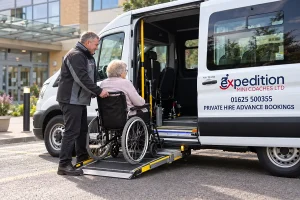
Finding the right wheelchair transport service is about more than simply finding a vehicle with wheelchair access. The passenger’s comfort, safety, mobility requirements and the level of assistance they need should all be considered before booking.
At Expedition Mini Coaches, we understand that every passenger has different requirements. Whether you are arranging wheelchair transport for yourself, a family member, a care home resident or someone attending a hospital appointment, choosing an appropriate transport provider can make the journey considerably easier.
Here are some of the key things to consider when booking wheelchair-accessible transport.
1. Is the vehicle genuinely wheelchair accessible?
One of the first things to establish is whether the vehicle is properly equipped to transport a wheelchair user.
Wheelchair-accessible vehicles should provide a suitable method of getting the passenger safely into and out of the vehicle, as well as an appropriate space for the wheelchair during the journey.
When booking, tell the transport provider that the passenger will be travelling in a wheelchair and provide any relevant information about the wheelchair being used.
This allows the provider to determine whether the vehicle is suitable before the journey takes place.
2. Does the provider understand the passenger’s mobility requirements?
Not every wheelchair user has the same needs.
Some passengers may be able to transfer from their wheelchair into a vehicle seat, while others may need to remain in their wheelchair throughout the journey. Other passengers may be able to walk a short distance but still require a wheelchair for longer distances.
This is why it is important that the transport provider asks about the passenger’s individual mobility requirements when the booking is made.
At Expedition Mini Coaches, we recommend providing as much information as possible in advance so that the journey can be planned appropriately.
3. Is assistance available when getting into and out of the vehicle?
For many passengers, accessible transport isn’t simply about the vehicle itself.
A passenger may require additional time or assistance when boarding or leaving the vehicle, particularly if they are elderly, have reduced mobility or are travelling following medical treatment.
When arranging wheelchair transport, ask what assistance the driver or transport team can provide.
If the passenger has particular requirements, these should be discussed before the day of travel rather than waiting until the vehicle arrives.
4. Is the journey planned around the passenger?
Hospital and healthcare journeys often involve specific appointment or collection times.
When arranging wheelchair transport to a hospital appointment, make sure sufficient time is allowed for boarding, travelling and arriving at the correct part of the hospital.
Large hospitals can also have several entrances and departments, so providing accurate destination information can help the journey run more smoothly.
For hospital discharge collections, timings can sometimes change, so communication between the passenger, family, hospital and transport provider can be particularly important.
5. Will the journey be comfortable?
Comfort becomes especially important on longer journeys.
A wheelchair user travelling to a specialist hospital or healthcare facility may spend considerably longer in the vehicle than someone making a short local journey.
When booking long-distance wheelchair transport, it is worth discussing the expected journey time and any particular requirements the passenger may have.
The aim should be to make the journey as comfortable and straightforward as reasonably possible.
6. Can a relative or carer travel with the passenger?
Some passengers may feel more comfortable travelling with a relative, friend or carer.
If someone needs to accompany the wheelchair user, mention this when making the booking so that appropriate passenger capacity can be confirmed.
This can be particularly important when arranging transport for elderly passengers, care home residents or people travelling for medical treatment.